Learn why an Automation Testing Career is a smart choice over manual testing and how it can advance your journey in software industry.
In the rapidly evolving software industry, choosing the right QA career path is crucial. One of the most common questions beginners ask is:
“Should I choose automation testing or manual testing as a career?”
While manual testing remains important, automation testing has become the future of software testing. In this article, we’ll explore why automation testing is a better career choice, along with its benefits, salary potential, and growth opportunities.
What is Automation Testing?
Automation testing is the process of using tools and scripts to execute test cases automatically, without human intervention. Popular tools include:
It is widely used in Agile and DevOps environments to ensure faster and more reliable software releases.
What is Manual Testing?
Manual testing involves testers manually executing test cases without using automation tools. It is useful for:
- Exploratory testing
- Usability testing
- Ad-hoc Testing
- UI validation
However, it can be time-consuming and repetitive.
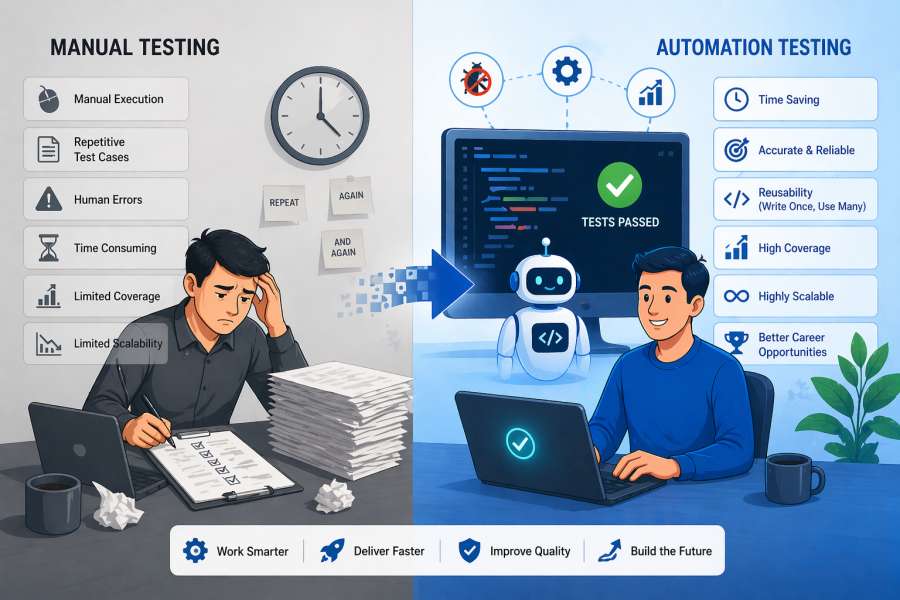
| Feature | Manual Testing | Automation Testing |
|---|---|---|
| Execution Speed | Slow | Fast |
| Reusability | Low | High |
| Test Coverage | Limited Test Coverage | More Test Coverage |
| Skills Required | Basic testing knowledge | Programming knowledge |
| Career Growth | Limited | High |
| Salary Potential | Lower | Higher |
Top Reasons to Choose Automation Testing as a Career
1. High Demand for Automation Testers
With companies adopting Agile and DevOps, automation testing is no longer optional—it’s essential. According to industry reports, automation testing roles are growing significantly faster than traditional QA roles. This demand translates directly into:
- More job openings
- Better job security
- Global opportunities
2. Higher Salary Packages
Automation testers typically earn more because they bring additional value:
- Programming knowledge (Java, Python etc.)
- Framework design skills (Page Object Model (POM), Data-Driven, and Hybrid frameworks etc.)
- CI/CD & DevOps Integration (Git, Jenkins etc.)
Even at entry level, automation testers often earn significantly more than manual testers. As you gain experience, the gap widens further.
3. Faster Career Growth
Automation testing opens doors to advanced roles such as:
- Test Architect
- DevOps Engineer
- QA Automation Engineer
- SDET (Software Development Engineer in Test)
This makes it a more scalable career path compared to manual testing.
4. Automation Testing Saves Time and Effort
Manual testing involves repetitive tasks:
- Running the same test cases
- Checking regression scenarios
- Test Data Setup
- Report Generation
- Logging bugs manually
- Cross-Browser/Cross-Platform Testing
Automation eliminates this repetition. Once scripts are written:
- Using frameworks like Selenium or Cypress, write a test once and run it unlimited times with a single command.
- They can run repeatedly without extra effort
- Automation tools and scripts can generate, fetch, or reset test data automatically.
- Automation frameworks generate detailed reports instantly after execution.
- Automation can’t fully eliminate bug reporting, but it reduces manual effort significantly. When a test fails: Logs, stack traces, and screenshots are captured automatically.
- Automation testing enables running tests across multiple devices and browsers in parallel, significantly reducing overall execution time.
- Automation test reduce human fatigue.
This makes your work smarter, not harder.
5. Future-Proof Skills
Learning automation testing helps you gain in-demand technical skills:
- Programming (Java, Python, JavaScript etc.)
- Framework design
- CI/CD tools
- DevOps & Containerization
These skills ensure long-term career stability.
6. Better Integration with Modern Technologies
Automation testing integrates with:
- CI/ CD (Continuous Integration & Delivery) pipelines
- Containerization & Cloud Platforms
- Version Control Systems
- Cloud platforms
- Build Tools
- AI-driven testing tools
It enables faster releases without compromising quality.
7. Global Job Opportunities – In Automation Testing Career
Automation testing skills are recognized worldwide, making it easier to find remote jobs and international opportunities.
Is Manual Testing Still a Good Career?
Yes, manual testing is still relevant, especially for:
- Beginners starting in QA
- Exploratory testing
- Usability testing
- Ad-hoc testing
However, relying only on manual testing may limit your growth in the long run.
Real-World Insight: Career Growth Trajectory
Let’s look at how careers typically evolve:
Manual Testing Path:
Tester → Senior Tester → QA Lead → Test Manager → QA Manager / Head of QA
(Growth slows after a point)
Automation Testing Path:
Automation Tester → SDET → Test Architect → Engineering Leader
(More technical growth + higher ceiling)
Automation opens more doors—not just within QA, but across the tech ecosystem.
Challenges in Automation Testing (And Why They’re Worth It)
Common Challenges:
- Learning programming
- Understanding frameworks
- Debugging scripts
Why It’s Still Worth It:
- These skills increase your market value
- They make your profile stand out
- They future-proof your career
How to Start a Career in Automation Testing
If you’re a beginner, follow this roadmap:
- Learn manual testing basics
- Pick a programming language (Java, Python)
- Learn automation tools like Selenium or Playwright
- Learn Framework Design
- Understand CI/CD pipelines
- Work on real-world projects
- Prepare for Interviews
Want a more detailed guide? Read our complete Automation Testing Roadmap to learn everything step by step.
Conclusion
Automation testing is clearly the better career choice due to its high demand, better salary, and future growth opportunities. While manual testing is a good starting point, transitioning to automation testing is essential for long-term success in the software testing field.
FAQs
Is automation testing better than manual testing?
Yes, automation testing offers better career growth, higher salary, and aligns with modern development practices.
Can I switch from manual testing to automation testing?
Absolutely. Many professionals start with manual testing and later transition into automation testing.
Is coding required for automation testing?
Yes, basic programming knowledge is required to write automation scripts.